Originally called the New Ducal Theatre, the Teatro Regio in Parma was built at the behest of the Duchess Maria Luigia of Habsburg-Lorraine, wife of Napoleon, who was sent to govern the Duchy of Parma, Piacenza and Guastalla following the Congress of Vienna. Work began in 1821 on a project by the court architect Nicola Bettoli and the Theatre opened on 16thMay 1829 with Zaira by Vincenzo Bellini with a libretto by Felice Romani.
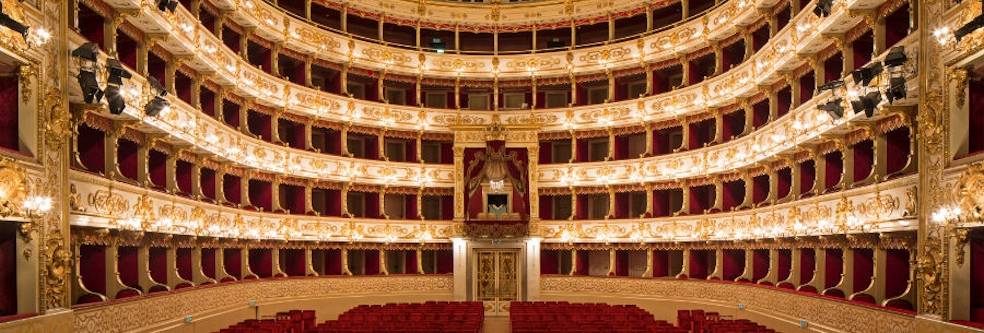
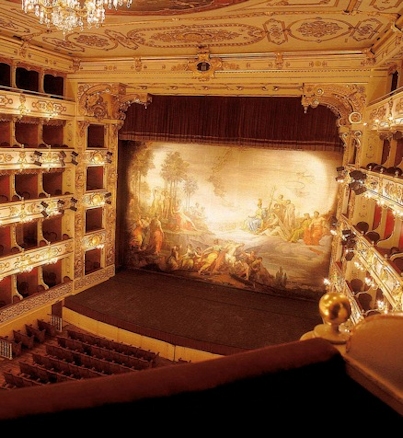
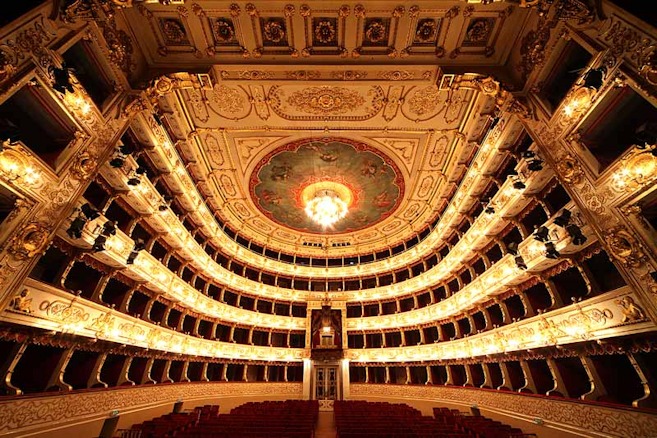
Built in the neo-classical style, the façade is characterized by a colonnade with ionic capitals with a large thermal window above. Having entered the theatre, we accede to the Foyer adorned with two rows of four columns and still visible on the floor the grills once used for heating the theatre. A staircase leads up to the large salon called the ‘ridotta’, where Maria Luigia’s throne was situated. The Duchess had direct access to this salon from the Ducal Palace. Two large blown glass chandeliers hang from the ceiling and the tribunes for the dance orchestra overlook the large space. Returning to the foyer, entrance to the main body of the theatre is through the door of honour: the stalls area, four orders of boxes and the gallery and the ceiling painted by Giovan Battista Borghesi with poets and dramatists painted in a circle around the great “astrolamp”. This lamp in gilded bronze was ordered from the workshop of Lacarrière in Paris. The theatre curtain is also the work of Borghesi and is one of the very few to have survived to the modern day; it depicts an allegory of wisdom with Minerva enthroned surrounded by Gods, nymphs, poets and muses. Minerva is a portrait of Maria Luigia herself. Above the curtain is the special clock ‘a luce’ which tells the time in five minute intervals; it is in the centre of the proscenium arch and on either side of the arch can be seen gilded busts of poets and composers. As we see it today the Theatre is very different from the original; in 1853 the neoclassical décor designed by Paolo Toschi was covered with the gilding and stucco work of Girolamo Magnani who had renovated the newly named Teatro Regio at the behest of Carlo III Bourbon using the new-renaissance style. Magnani was the set designer preferred by Verdi and they often worked together. That same year the new chandelier inaugurated the arrival of gas lighting in the theatre replacing the previous system of candles and oil lamps. Electrical illumination arrived in 1890 and the chandelier was cut down in 1913 to improve visibility from the gallery. The acoustic chamber painted by Giuseppe Carmignani, another rare survivor from past times, repeats the decoration of the boxes and consists of wood framed canvas panels, which can be opened and closed telescopically to function with orchestras of different sizes and formations.
Originally the Theatre was destined for various types of spectacle, from opera to dance, from poetic declamation to the most diverse art forms; funambulism, gymnastics, acts with animals, scientific demonstrations, illusionism and displays of ‘curiosities’. Right from its inauguration, the Theatre has born witness and been a protagonist of the crucial changes which affected melodrama during the XIX and XX centuries, from the end of the period of Rossini to the triumph of the Verdi repertoire, to appreciation of the French and German experience, to the extreme evolution in terms of realism of Italian opera with Mascagni, Leoncavallo and Puccini.